Macro Snapshot – July 2026

June 2026 Market Trends: Rotation Beneath the Surface
June looked resilient at first glance. Regional equities outside the U.S. performed well, bonds stabilised, and commodities weakened sharply. Much of the month’s character stemmed from de-escalating geopolitical tensions around Iran, including ceasefire extensions and progress toward reopening the Strait of Hormuz, which triggered a sharp drop in oil prices and eased near-term inflation fears.

The market was not simply embracing risk; it was reassessing energy pressure, inflation assumptions and the durability of recent U.S.-led equity leadership. Beneath the surface, AI-driven earnings momentum and technology capex continued to underpin broader market resilience, even as some mega-cap names saw profit-taking and leadership broadened.
In the UK, the policy backdrop remained finely balanced. The Bank of England held the Bank Rate at 3.75%, but the 7–2 vote, with two members favouring an increase to 4%, showed that inflation risk was still alive.
The data supported that caution. CPI inflation was unchanged at 2.8% in the 12 months to May, while real GDP growth was more constructive at 0.7% in the three months to April.
The wider policy backdrop was cautious too. The Federal Reserve held rates in June, and the ECB revised its 2026 headline inflation projection higher to 3.0%, partly because of energy prices.
Monthly and long-term performance snapshot
The June performance table shows a clear split between regional equities, bonds and commodities.
China, India, global real estate and Europe were the strongest areas, while U.S. equity paused and oil posted the largest monthly fall in the supplied data.
The one-year picture tells a different story. Brent crude oil, China equity, emerging markets equity, global equity, U.S. equity, gold, silver and copper all remained strongly positive over 12 months.
June was a weak month for commodities, but not a reversal of their longer-term strength. It was a positive month for bonds, but not enough to erase the pressure still visible in parts of fixed income. Short-term rotation and longer-term leadership are not the same thing.
The charts below provides a snapshot of unhedged index fund investment returns across a range of asset classes and regional exposures, measured in sterling terms.
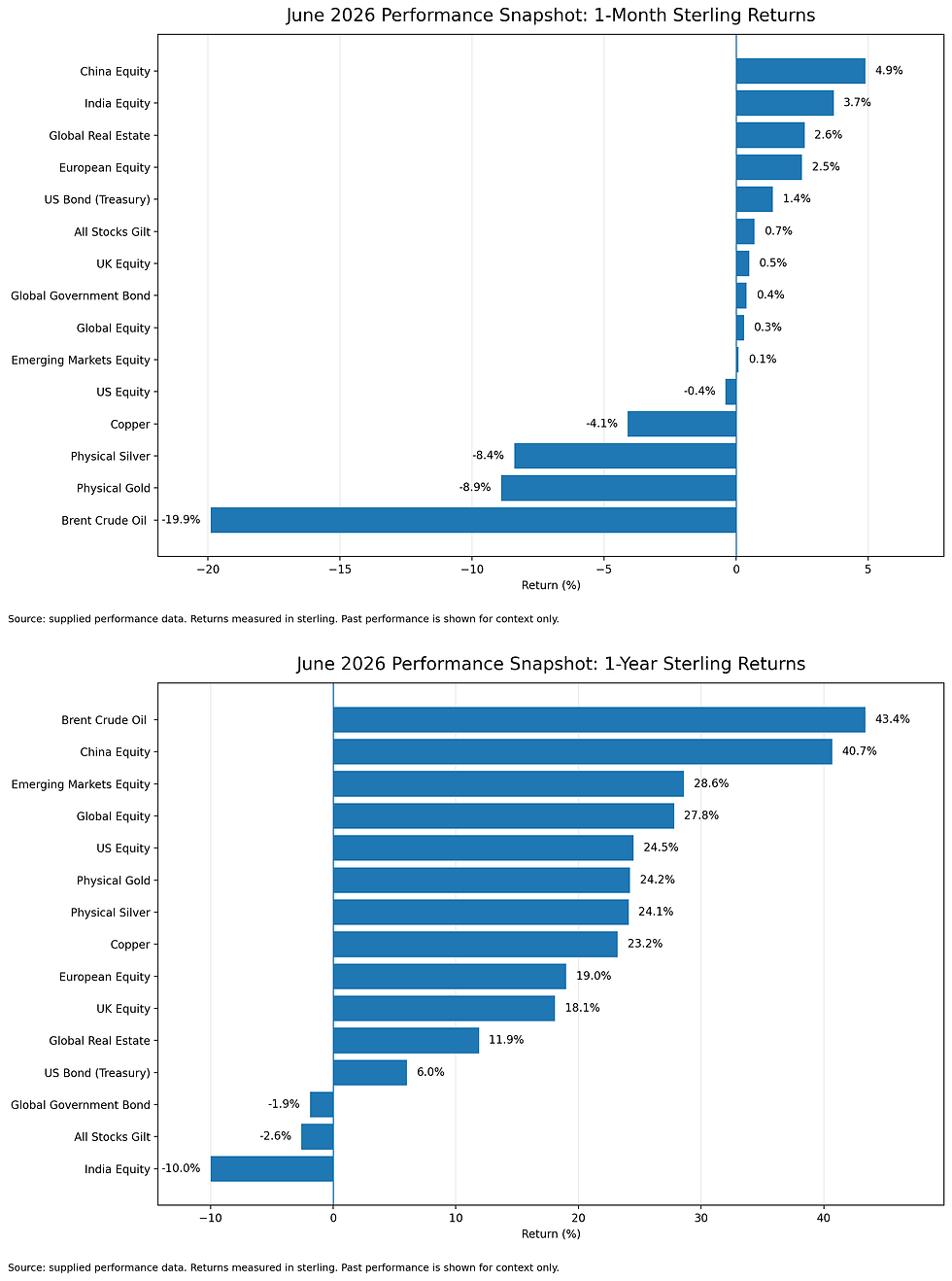
Past performance is shown for context only. Returns are measured in sterling.
Oil reset the inflation narrative
Brent crude’s 19.9% fall was the clearest macro signal in the June data.
Oil had been doing much of the work in the inflation debate, linking geopolitical risk, supply disruption and central-bank caution. A sharp fall therefore eased one of the market’s more visible pressure points.
But it did not remove the risk. Brent crude was still up 43.4% over one year, so June looks more like a pause in the energy shock than a clean reversal.
For portfolios, the question is not whether oil had a weak month. It is whether inflation, rate and valuation assumptions have become too reliant on energy markets staying calm.
Equity leadership moved away from the U.S.
China and India led the month, while Europe and global real estate also delivered positive returns. The U.S. paused, slipping slightly in sterling terms after a strong year.
While the long-term narrative for U.S. equities remains intact, supported by a 24.5% gain over the past year, this shift highlights how rapidly leadership transitions when valuations, currencies, earnings expectations, and policy assumptions are simultaneously reassessed.
The core issue seems now to be building evidence that extends beyond the sustainability of U.S. exceptionalism; it is a question of whether portfolio return expectations have become overly dependent on a single region, investment style, or earnings narrative to drive performance.
Bonds stabilised, but the test is not over
June gave fixed income some relief, but not a clean reset.
U.S. Treasuries led the main bond exposures in the data we cover, while gilts and global government bonds also rose. Over 12 months, however, the picture remained mixed, with U.S. Treasuries positive but all-stocks gilts and global government bonds still negative.
The issue is that bond behaviour remains highly conditional. Duration can help in a growth scare, but may struggle when the shock is inflation-led and central banks have less room to respond.
Precious metals were not immune to rotation
Gold and silver fell sharply in June, even though both remained strongly positive over one year.
That suggests positioning shifted, rather than the longer-term case disappeared. As oil disruption risk faded and real-yield expectations moved, some safe-haven and inflation-hedge demand may have unwound.
Assets that feel defensive in one regime can still fall sharply when the market changes the question it is asking. Diversifiers should therefore be judged over a full cycle, not by whether they work in every difficult month.
What stands out for investors
Regional equity leadership broadened away from the U.S., with China, India, Europe and global real estate all positive.
Oil was the biggest swing factor, falling sharply over the month but remaining strongly positive over one year.
Gold and silver weakened, showing that diversifiers can still struggle when the market narrative changes.
Bonds stabilised, but the longer-term fixed-income picture remains mixed.
The more useful portfolio question is not what led last month. It is what assumptions are embedded in current prices, and which parts of the portfolio are most exposed if those assumptions change.
In summary
June was a month of rotation beneath the surface.
The fall in oil changed the inflation narrative, at least in the short term. Bonds stabilised. Equity leadership moved away from the U.S. But commodities and precious metals weakened sharply, and the broader macro backdrop remained unresolved.
Inflation is still above target in the UK. Central banks remain cautious. Energy markets are still politically sensitive. None of that points to a simple environment.
The practical lesson is that portfolio behaviour matters more than headline labels. Diversification is not simply about owning more things. It is about understanding which risks are being taken, which assumptions are already priced in, and which parts of the portfolio may behave differently when the market narrative changes.
Disclaimer: This commentary is for informational purposes only and reflects general market observations. It does not constitute investment advice, a recommendation, or an invitation to engage in any investment activity. Everyone’s situation is different, so if you are unsure about a decision, it’s important to seek guidance from a qualified financial professional.
The views, forecasts and figures included reflect analysis at the time of writing, unless otherwise stated. Sources used are believed to be reliable, but markets and circumstances can change quickly, which means our views may also evolve over time.
